This weekly newsletter highlights the latest from the California Energy Journal along with links to articles and analysis on key developments in California energy policy.
Questions, comments, or tips? Contact editor@californiaenergyjournal.com.
From the California Energy Journal
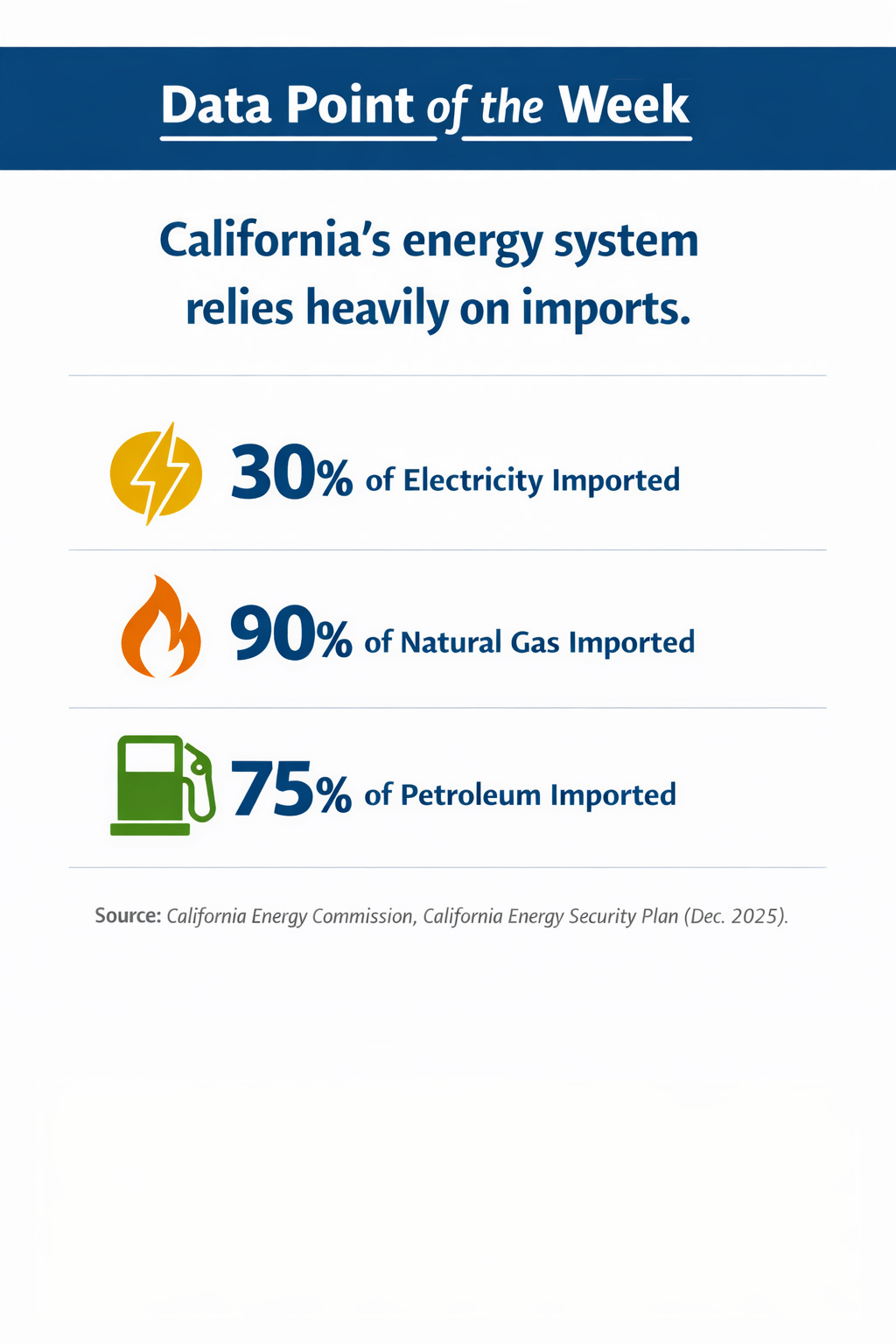
CEC Report Warns California’s Reliance on Imported Energy Creates Supply Risks (February 25, 2026) – A new state energy security report warns that California’s heavy reliance on imported electricity and fuels exposes the state to potential supply disruptions as energy demand grows and infrastructure changes. The California Energy Commission (CEC) in December 2025 released an updated California Energy Security Plan, evaluating risks across the state’s electricity, natural gas, and transportation fuel systems. Read more.
Court Upholds Injunction Blocking Restart of Sable Offshore Pipeline (March 2, 2026) – On February 27, 2026, Santa Barbara County Judge Donna Geck intends to uphold a preliminary injunction that blocks Sable’s restart of the Las Flores Pipeline system. Sable challenged a July 2025 preliminary injunction against the Office of the State Fire Marshal (OSFM), finding that it likely violated state law in its approval of a waiver that allowed Sable to restart the pipeline. Read more.
BOEM Launches Environmental Review for Potential California Offshore Lease Sales (February 27, 2026) – The U.S. Bureau of Ocean Energy Management (BOEM) announced that it will begin preparing a programmatic environmental impact statement (PEIS) for potential oil and gas lease sales off the coast of California. The review encompasses the Northern, Central and Southern California Planning Areas of the Outer Continental Shelf (OCS). Read more.
Additional California News and Analysis
Oil and gasoline
The Phillips 66 Los Angeles Refinery could be a test case for how the state and local governments should handle refinery closures, experts say. Daily Bulletin, March 2, 2026.
Refinery closures in California are resulting in more sea-borne gasoline imports to the state. Imports of California’s boutique gasoline fuel are coming from India, South Korea, and even the Bahamas, as West Coast refineries are shipping petroleum products to California via the Bahamas to comply with the Jones Act. IER, February 26, 2026.
Crimson California Pipeline LP requested that the California Public Utilities Commission (CPUC) authorize it to increase crude oil transportation rates on its southern California pipeline system by 66.97%, retroactively effective as of April 1, 2026. CPUC, February 27, 2026; California Regulatory Intelligence, February 27, 2026.
Some state lawmakers are proposing a temporary pause to California’s gas tax as prices at the pump continue to rise, leaving drivers in the state paying among the highest fuel costs in the country. KFSN, February 25, 2026.
Commentary and analysis
Matthew Green, “An oil refinery defined life in this quaint California city. What happens when it’s gone?, The Guardian, February 26, 2026.
Damien Newton, “Republican’s Demagogue on Suspending Gas Tax and Climate Fuel Rules — Again,” StreetsBlogCal, February 25, 2026.
Offshore oil
A coalition of 38 California Democratic congressional lawmakers sent a letter to Trump and Interior Secretary Doug Burgum asking that the administration extend the public comment period on proposed offshore oil and gas leases off the California coast by 90 days. Politico, February 23, 2026; Santa Barbara Independent, February 24, 2026.
California Natural Resources Agency Secretary Wade Crowfoot sent a letter to the BOEM to express opposition to new lease sales off the California coast. Politico, February 24, 2026.
Nuclear
Central Coast Water authorities approved waste discharge permits for Diablo Canyon nuclear plant, making it nearly certain it will remain running through 2030, and potentially through 2045. The Pacific Gas & Electric-owned plant was originally supposed to shut down in 2025. Los Angeles Times, Sacramento Bee, February 26, 2026.
Commentary and analysis
Lauren Hanson and Mary Jones, “Diablo Gets Its Permits,” Santa Barbara Independent, February 28, 2026.
Sarah Rosa, “Not a Moment Too Soon, California moves to embrace nuclear energy,” Orange County Register, February 26, 2026.
Power and utilities
The California Public Utility Commission voted unanimously to order state load-serving entities to procure a total additional 6 GW from 2029 to 2032 to cover an anticipated reliability shortfall resulting from demand growth. Utility Dive, February 27, 2026; CPUC, March 2, 2026.
Commentary and analysis
Ben Christopher and Alejandro Lazo, “California wants millions of heat pumps. High power bills might get in the way,” CalMatters, February 23, 2026
Carbon reporting
CARB approved a climate transparency regulation package tied to SB 253 and SB 261 at its February 26, 2026 board meeting, including a fee structure and setting August 10, 2026 as the first-year SB 253 reporting deadline (with initial-year reporting limited to Scope 1 and Scope 2. CARB, February 26, 2026.
Alternative fuels
Aaron Smith, “High Costs and Few Benefits from California’s Proposed Sustainable Aviation Fuel Tax Credit,” Energy Institute Blog, February 24, 2026.
Energy policy
Commentary and analysis
Edward Ring, “Can Energy and Water Interests Find a Common Agenda?,” California Policy Center, February 25, 2026.
Legislation
State senators introduced new legislation in an “electricity and gasoline affordability legislative package:
SB 929 would require the chair of the California Energy Commission to appear annually before the appropriate policy committees of the Legislature to report on activities of the commission.
SB 1239 would require the California Air Resources Board (CARB) to prepare and publish a supplemental standardized regulatory impact analysis if the proposed regulation is materially changed after release of the initial standardized regulatory impact analysis and that updates the consumer cost analysis to reflect amendments made during the rulemaking process.
SB 981 would require a standardized regulatory impact analysis prepared by CARB to additionally address cost of living impacts on residents of the state, including, but not limited to, retail gasoline and transportation costs, consumer electric bills, consumer goods and food costs, housing and building construction costs, and costs to businesses.
Additional News and Analysis
Data centers and AI
In his State of the Union, President Donald Trump said technology companies will pay for their own power generation as electricity prices rise. E&E News, February 25, 2026.
The House passed legislation Tuesday that would give the federal government new authority to repeal existing energy efficiency standards while making it more difficult to adopt new ones in the future. E&E News, February 25, 2026.
Commentary and analysis
Hayley Smith, “Trump’s plan for rising energy costs: Pump oil, make data centers pay,” Los Angeles Times, February 25, 2026.